
Zipline
Drone logistics for good

In the greatest TV show of all time, The West Wing (not a debate, this newsletter is a dictatorship and I brook no opposition) there is a scene near the end of the series when all the staff are looking for new jobs and CJ Cregg (White House Chief of Staff) meets with a fictional billionaire who wants to set up a foundation to empower her to fix a single problem in the world. She chooses infrastructure, arguing that without it, medicines can’t get where they need to be and neither can the people who need to administer them. Watch the clip - it’s so good. I miss the West Wing. Anyway, I digress….
Needless to say the highways and roads didn’t quite materialise as much as we may have wanted them to since 2006 when The West Wing ended or if they did, they haven’t quite stood the test of time. But that’s OK, we built machines that can fly.
Well we didn’t. Zipline did. And what does Zipline do?
In a nutshell, Zipline uses electric, emission free drones to deliver life-saving medicine and equipment to hospitals where there’s no easy way to otherwise get them there. Zipline started delivering in Rwanda in 2016 and then expanded to Ghana, Kenya, Nigeria, Côte d’Ivoire and Japan. It also has home delivery operations in the US which I’ll get to slightly later.
OK, let’s talk some numbers
There are a lot of numbers - I’m not gonna give you them all but here are some important headline figures:
101,203,048 miles flown
1,439,914 deliveries made
15,144,937 items delivered
Zipline serves more than 4,500 health centers and more than 45 million people
Zipline delivers 75% of Rwanda’s blood supply outside the country’s capital city
Zipline now flies the equivalent of the circumference of the earth every six hours
OK OK so some impressive stats but is it working? Time for more bullet points:
Zipline has delivered more than 20m vaccine doses (contrary to what you may have heard, vaccines are good actually)
A study in The Lancet, showed that Zipline’s service resulted in a 67% reduction in blood wastage across Rwanda.
A Gates Foundation funded study found that vaccine stockouts are 60% shorter at Zipline-served facilities than facilities not served by Zipline.
A Wharton study found use of Zipline’s logistics and delivery system led to a 51% reduction in Rwanda of in-hospital maternal deaths due to postpartum hemorrhaging.
A study by the Ghanaian Ministry of Health and Zipline found a 56% reduction in maternal deaths in Northern Ghana, along with secondary benefits including decreased emergency visits, increased referrals, and perceived improvements to healthcare access from both patients and providers.
So just routinely saving lives. These guys fucking rock, can I see a short 1 minute and 46 second video about how it all works?
Goddamn that’s specific but what do you know, I have just the thing:
This is incredibly impressive and life-saving and all that but can they also deliver sandwiches?
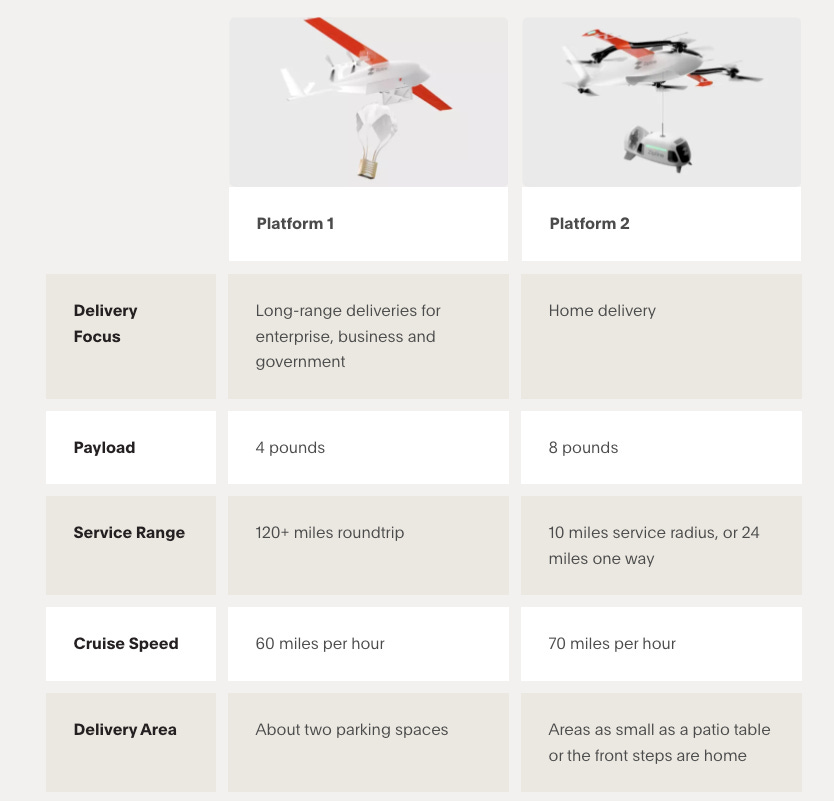
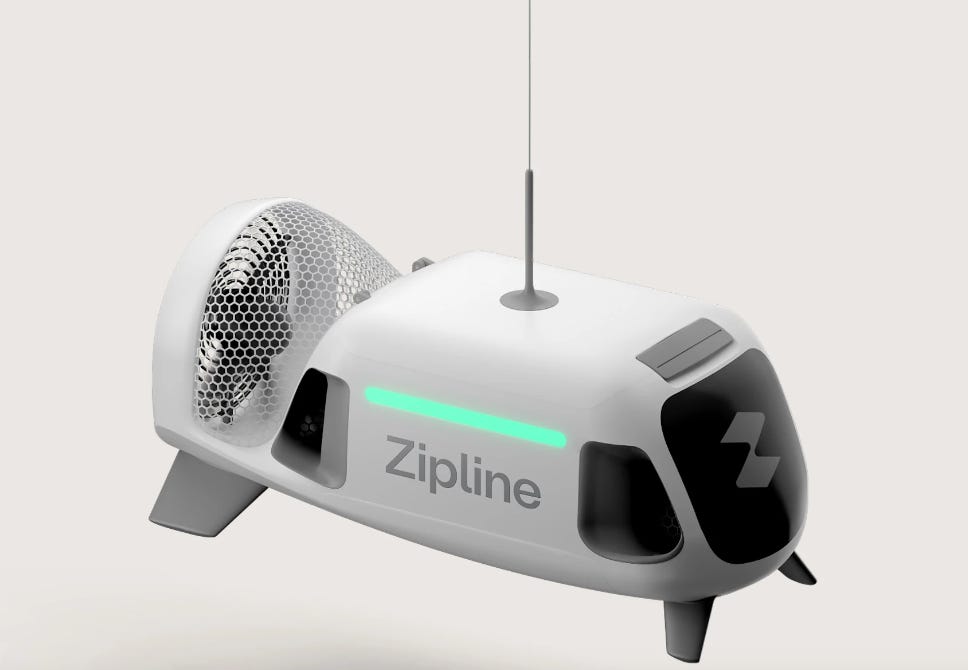
Hell yeah they can! As I mentioned earlier, Zipline launched home deliveries in select US markets in 2022. They’ve partnered with companies like Walmart, Panera Bread and Sweet Green to deliver food, groceries and more to folks in Texas and Arkansas. In order to operate in this more built up environment, they’ve developed a new drone (the P2) capable of landing a delivery on your patio table. Whereas their healthcare drones in Africa drop with a parachute, their more precise delivery drones actually drop a tethered delivery device precisely where it needs to be. And it’s not just the drones, Zipline has sorted out the whole stack from the dashboard to the fulfilment app.
Here’s a little side by side for you showing the difference in drones:
I mean look at this guy, straight out of Wall-e:
OK OK, enough of the cute drones and saving people lives. Can we talk money?
But of course. Zipline isn’t just a feel good charity story. These guys are a for-profit and have raised serious cash. $1.2bn to be exact. From some of the best investors in the world. I’m talking Sequioa, a16z, Temasek, Slow Ventures, even the US postal service. And this isn’t a pure 2021 peak, ZIRP phenomenon, Zipline raised in both 2023 and 2024 - neither years known to be particularly friendly to fundraising startups.
Nice! So who’s the brains behind this?

This guy is Keller-Rinaudo-Cliffton who, prior to Zipline was a professional rock climber (talk about nominative determinism). He founded Zipline in 2011 and has been working on it ever since. He really could end up being a one-company guy. Before Zipline and rock climbing, he was a scientist at the Bauer Lab at Harvard where he built molecular automata (DNA computers) that can be manufactured by human cells and can perform calculations based on gene expression on a cell by cell basis. Not even going to pretend I know what that means except that the guy is obviously exceptionally smart.
Why is this optimistic for the future?
I think this one is pretty obvious. To quote our man Keller; “Zipline is trying to build a new logistics system for Earth that approximates teleportation. So we use small, light, fast, electric, autonomous vehicles to deliver things in a way that is 10 times as fast as traditional logistics, half the cost and fully zero emission.”
Now if it ends up just being a faster Doordash/UberEats that will be super disappointing and a waste (in my eyes) but, everything I’ve learnt about the company tells me that that won’t be the case. Why start by delivering medicine in Africa if that’s all you wanted to achieve?
Imagine a world where you call emergency services and rather than waiting for an available ambulance as it weaves through traffic, a drone can airdrop you a defibrillator whilst the emergency responder on the phone talks you through how to use it. Or where fires like the ones that ripped through LA recently start and you have a whole fleet of drones dropping small but targeted payloads of water on them when they’re still small and controllable. Or (to go back to our original video of CJ) that places cut off by poor infrastructure aren’t disadvantaged by poor accessibility.
With Zipline we could deliver disaster relief safely and so much faster than ever before. At least for me, all of this is pretty optimistic.
OK you’ve sold me on it. Where can I find out more?