
We're living in a software developers world
and it's fucking us up


We humans are experts at lying to ourselves. We lie about when we’ll start our diet or start working out. We lie about how different we’re going to be tomorrow. We lie to ourselves about how good looking we are or how competent/smart we might be. The Dunning-Kruger effect is real.
The biggest lie we tell ourselves is that we are really and truly the architects of our own world. We believe that whilst others are susceptible to outside influences, that we, if not entirely impervious to them, are smart enough to recognise when we’re trying to be manipulated and therefore sidestep it.
And this may be true if someone is trying to get you to buy a new face cream or sign up to a charity donation in the street. But what about when someone/something is influencing the entire world around you? Can you spot it then? Can you grasp it when your whole reality is not in your own hands? Let me give you some examples because this isn’t an obviously easy concept to grok.
If you were alive during the time of Victorian England, the clothes you wore, the way you spoke, the job you did were all, in large part, decided not by you, but by an elite coterie in the court of Queen Victoria. It trickled down and you probably wouldn’t have realised it, believing all the decisions you made to be made solely by you. But they’re not, not really anyway. The shape and structure of society was decided, for the most part, away from you. Us normies are just tinkering at the margins.
This is most obvious, historically, by referring to reigns of kings and queens. For they were the ones that decided fashions, morals, even the gods we worshipped. They also decided whether we went to war and, if so, against whom.
As the power of monarchies and their courts waned, the mantle was taken up by politicians. Think of the Soviet Union, North Korea or Iran for example. Dictators entirely defining the parameters of their citizens lives. At least those people realise that they’re in totalitarian dictatorships though.
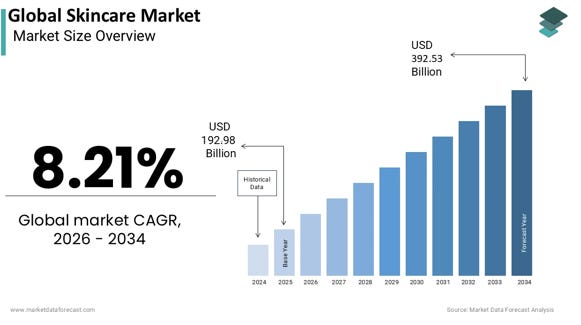
In the countries where Capitalism reigned, the influence of monarchs and politicians shattered and country leaders ceded the ground to marketers. We are so shaped by commercial influences and marketing campaigns that we never pause to wonder why the skincare market has exploded or why, a few years ago, everyone suddenly wanted to eat kale or why now everyone NEEDS to eat protein. We are being marketed to constantly and we don’t even realise how it’s impacting our decisions. For once, I find myself agreeing with Karl Marx when he said “we make our own history, but not under conditions of our own choosing.”
My main point is that we are not the architects of our lives as fully as we believe we are. We never really have been. And I want to be super clear here - I’m not making this point in a conspiratorial, “It’s the Illuminati” way. But it’s worthwhile noting that those kinds of conspiracy theories proliferate when people feel that the world isn’t their own but they can’t pinpoint whose it is. North Koreans know exactly who is architecting their world, they don’t have to hypothesise that it’s some shadowy cabal with ties to the Knights Templar.
And as for the architects of our (the West’s) current reality, well friends, I believe that the inheritor of the kings, queens and Mad Men of yore, is the very humble software developer.
And frankly, I think it’s making us crazy.
I work with and have worked with a lot of software developers over the last 14 years. Mostly, they are great people - whip smart, kind, super helpful. But, if you have an image in your mind of a stereotypical software developer you are probably imagining someone who may be slightly more awkward socially, more introvert than extrovert, more comfortable at a laptop than in a large crowd. And you wouldn’t be a million miles from the truth for the most part. Think Mark Zuckerberg before he consciously reframed his image as a cool guy with a chain.
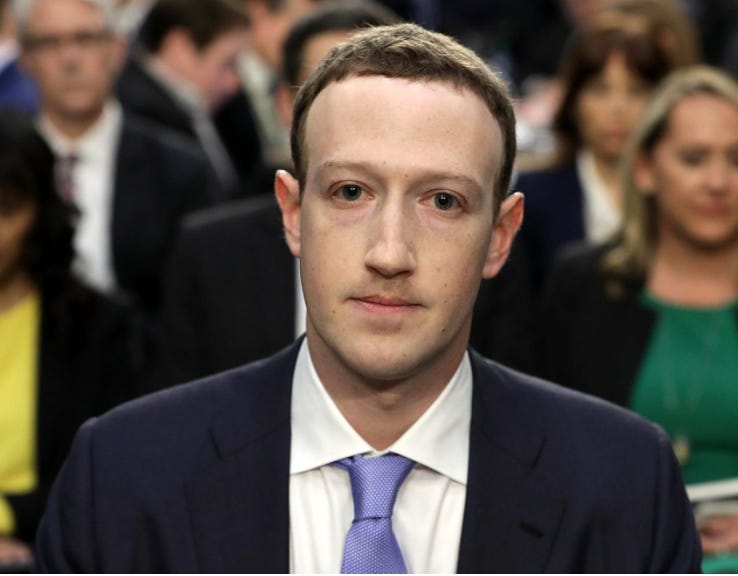
And it’s important to talk about Zuck here because not only is he the proto-geek, he is also THE role model for modern day tech founders. When you think of the other founder role models - Bezos isn’t deeply technical enough, Page and Brin are but they handed over power too quickly, Travis got fired and isn’t a developer anyway. Jensen is great but chips are very different from software. Elon is 1 of 1 but most software founders don’t want to build rockets or cars. Zuck built Facebook, told the Winkelvii to fuck off, had the balls to buy Instagram, he’s still in charge, retains control through dual shares and had one of the best movies of the 21st century made about him. Why wouldn’t he be the role model.
So as I go forward and talk about developers, think of founders and devs who model themselves on Zuck and then think what kind of world that that kind of person might want to live in.
And these developers (not in a concerted, conspiratorial way I want to state) have shaped the world around them and around us to such a degree that we’re now living in their reality. Let me give you some examples:
You used to have to hail a cab or call the cab company, you’d discuss price and destinations and actually have to hand over cash. No more - now you can be taken wherever you want without ever actually having to interact with the driver.
If you wanted to go on a date, you had to actually go out and meet people. Now you can sit at home and swipe til you match without ever actually venturing outside and facing possible rejection.
And sex? No thank you - I’ll just watch endless loops of porn forever and ever amen.
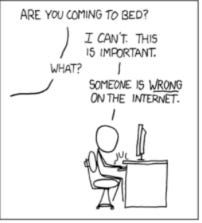
If you wanted to discuss anything with people from sports to politics to the OJ case, you actually had to go to common spaces and do it face-to-face. Now you get to argue with strangers on the internet for free.
Gaming - either board or video - if you wanted to do them with friends it had to be in person and now you can do everything from Scrabble to GTA with strangers without ever seeing them.
Even something like food delivery. You used to actually have to call a place, speak to another human being and make the order over the phone. Now it’s a couple of taps on an app, even tips are no longer awkward - it’s all taken care of my friend.
Worried that your taste in pop culture is too esoteric? Feel left out of the conversation? Don’t worry we’re going to entirely blow up any semblance of a monoculture with a million hours of content on Netflix, YouTube and TikTok that everyone can now live in their own esoteric bubble.
I, unabashedly, am amazing at talking to strangers on the phone. This is because I spent 12 months early in my career working on the HSBC small corporate Foreign Exchange desk speaking to business owners all day about their FX trades. Dozens a day, every day for a year. It built muscles I still use nearly 20 years later. Now we have entire generations freaking out about picking up the phone.
We have removed all the friction points of life in the name of efficiency and with it, we’ve removed the chance to interact with our fellow humans. Or to learn how to interact with them. This isn’t even to mention the times we might have spoken to someone else in a queue or on a train. Now we have an excuse to ignore everyone around us because we have something better to do than talk to strangers - we have our phones to look at. Serendipity be damned.
We didn’t realise that there was a battle but we lost it anyway. We bought the efficiency argument and eagerly signed up to a digital life that’s made us miserable. As Rousseau said "All ran to meet their chains thinking they secured their freedom." And that is what it increasingly feels like to live in this hyper-efficientized and frictionless world.
This world was created by software engineers to remove the awkward interactions that they, as perhaps more introverted people, found excruciating. And we’ve just gone along with it because, as I said, we notice less of this world creation/change. We mistakenly believe that we are all high agency but the truth is that, for the most part, we’re just swimming in someone else’s fishbowl.
And this particular fishbowl is really fucking us up. Maybe not in a “Now the King is sending me to Jerusalem to take it back for Christianity” kind of way but it’s messing with our heads in a hitherto unprecedented way.
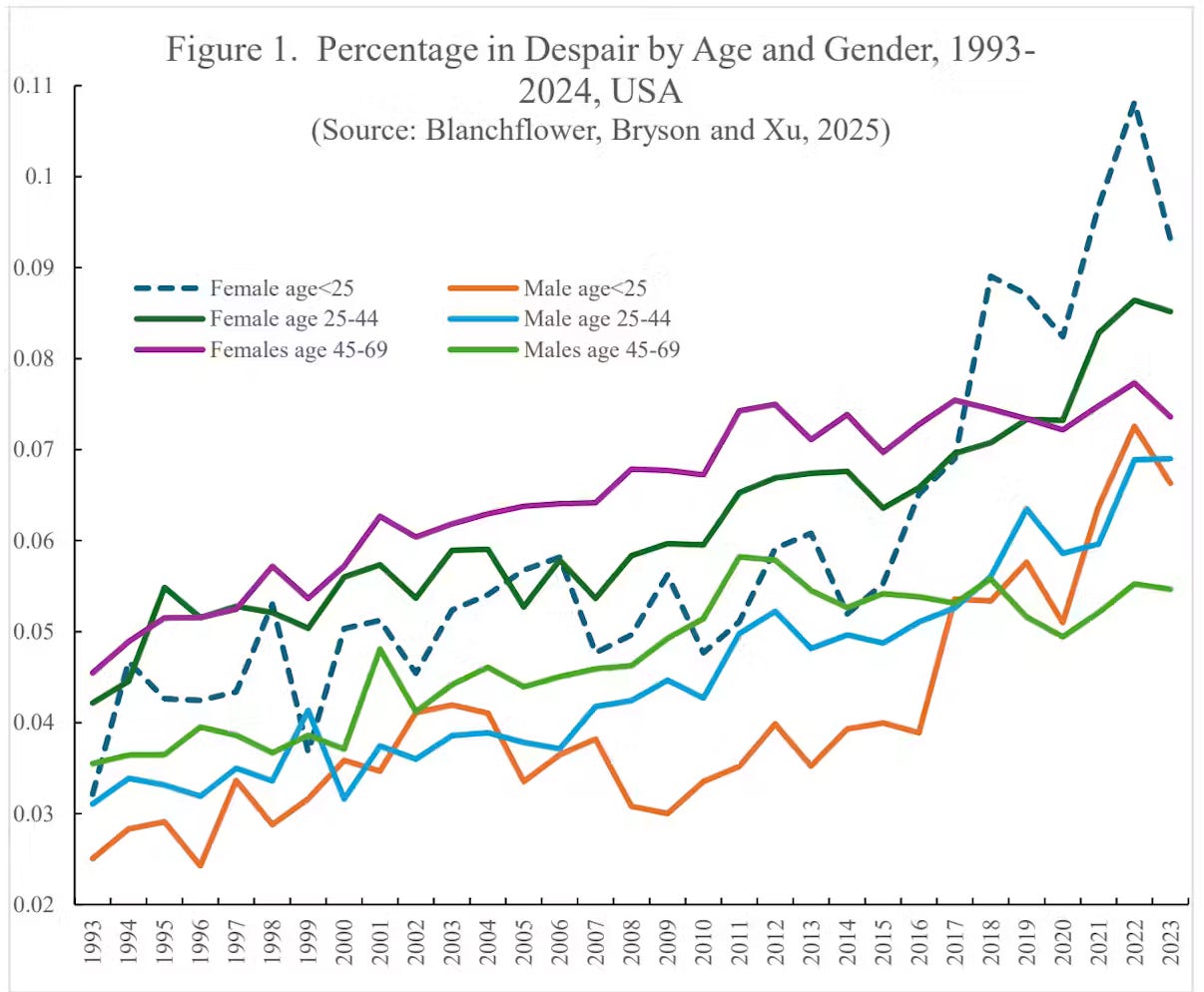
It’s no secret that loneliness, unhappiness and solitude have shot up, particularly over the last 10 years. They are all so interlinked that it’s impossible to separate them from one another.
This also, easily leads into phenomena like the “Manosphere” and incels - pathologies that could only really grow online because if you tried to espouse that shit to a real friend, in person, they’d hit you til they knocked the stupid out of you.
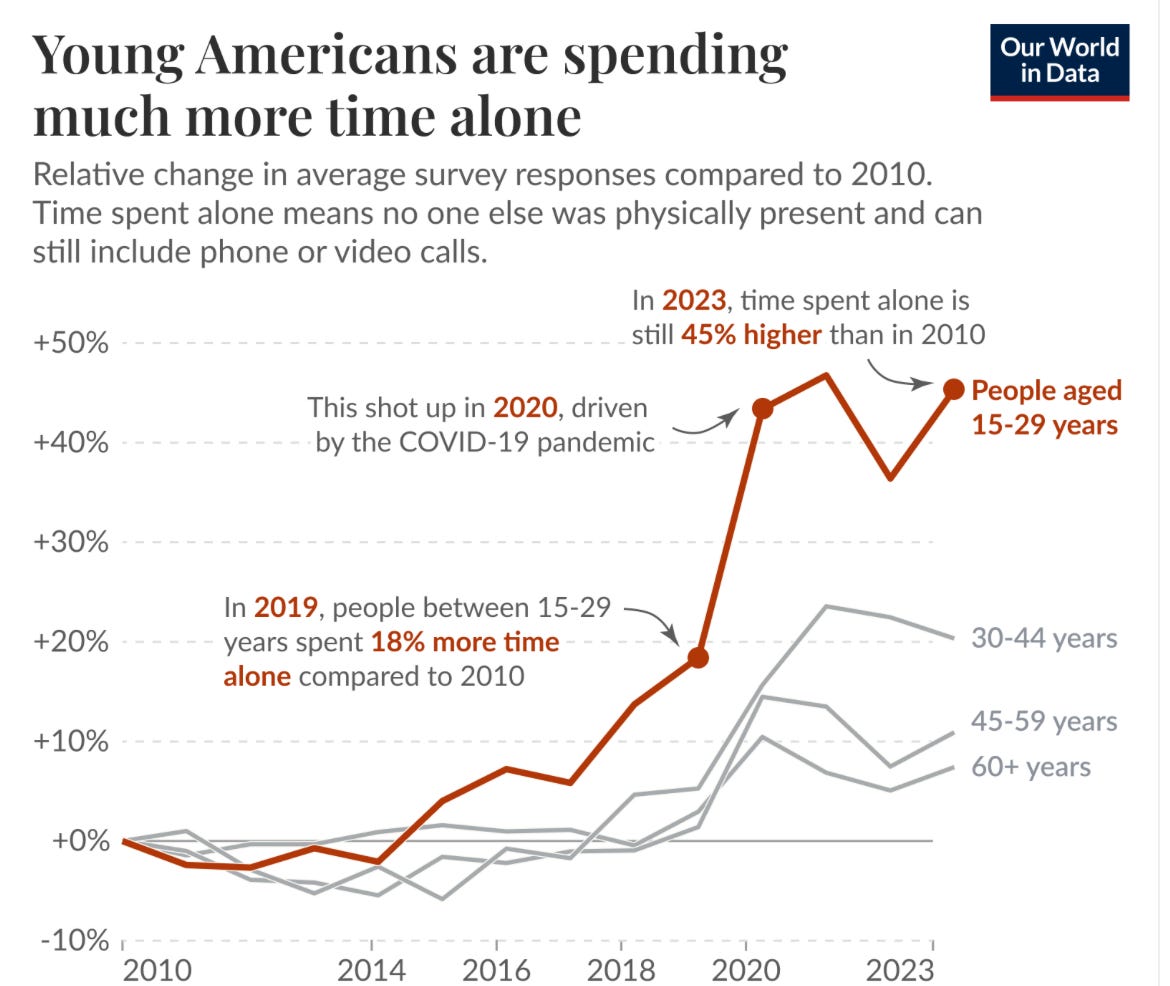
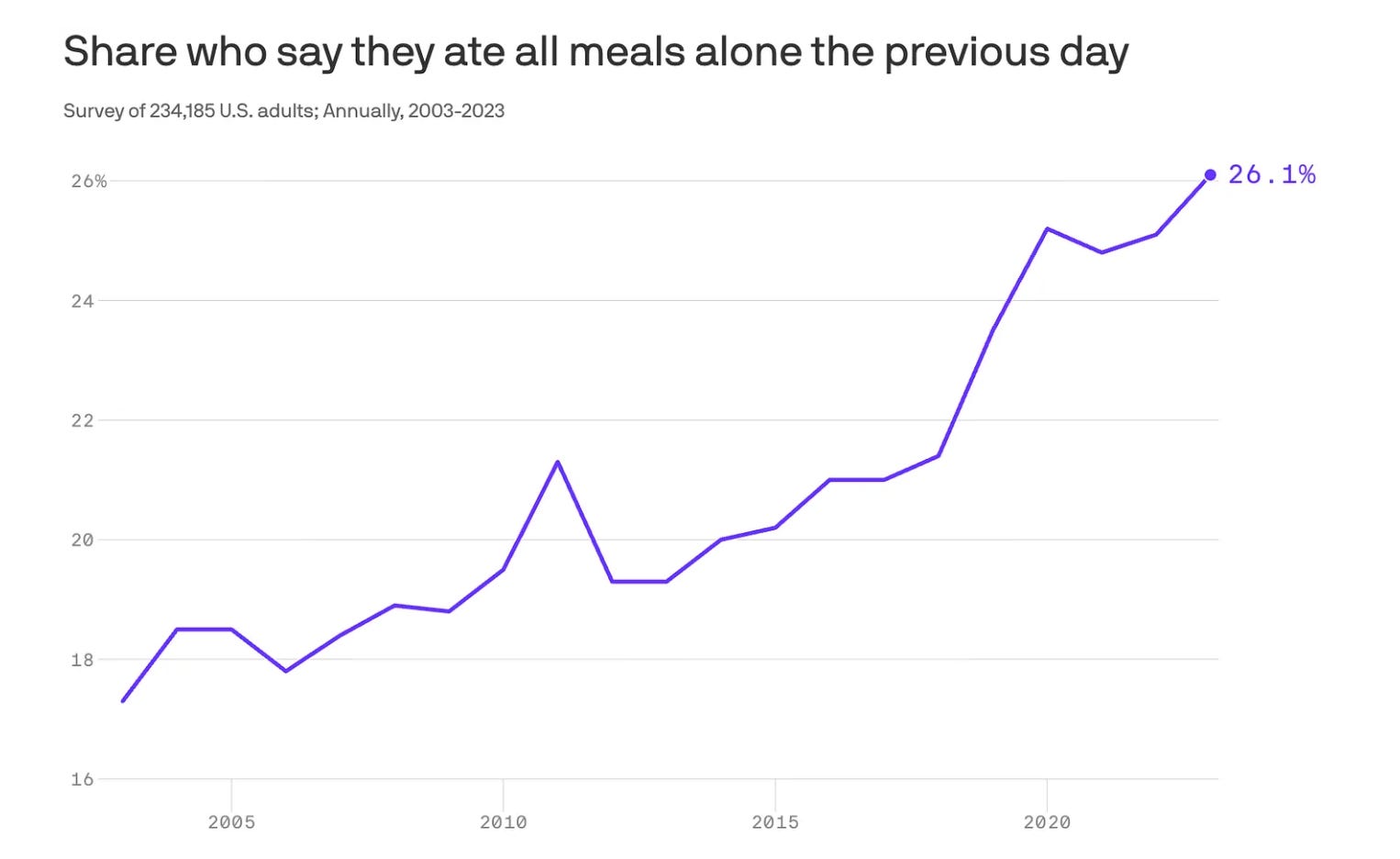
There are a lot of theories about what is leading to this monumental rise in sadness and solitude - from phones, to the economy, to the unaffordability of homes forcing people to delay the process of growing up, to the after-effects of Covid. There is no one theory fits all.
But, I do think that we have unwittingly allowed ourselves to live in a world designed by some of the most socially anxious and introverted people around. A world that fits their needs perfectly - minimal person-to-person interaction, everything done digitally and it’s fucking the rest of us up.
And it’s so incredibly important to contemplate this as that same class pushes the benefits of AI. We need to think very critically about the stories we accept and from whom before allowing our lives to be shaped by these forces.
It’s time to realise that we aren’t really the architects of our own world, that there is no single architect anymore. At least not in the democratic, liberal West. But the current architect class is that of the software developer, the engineer, the technologist.
And this class can’t force anything on us. Just see what happened when Zuck tried to shove everybody into the Metaverse (which by the way is the perfect distillation of this pheonmena - don’t meet people in real life, here’s a fucked up avatar of them instead) or Apple tried to convince us that this looked cool:
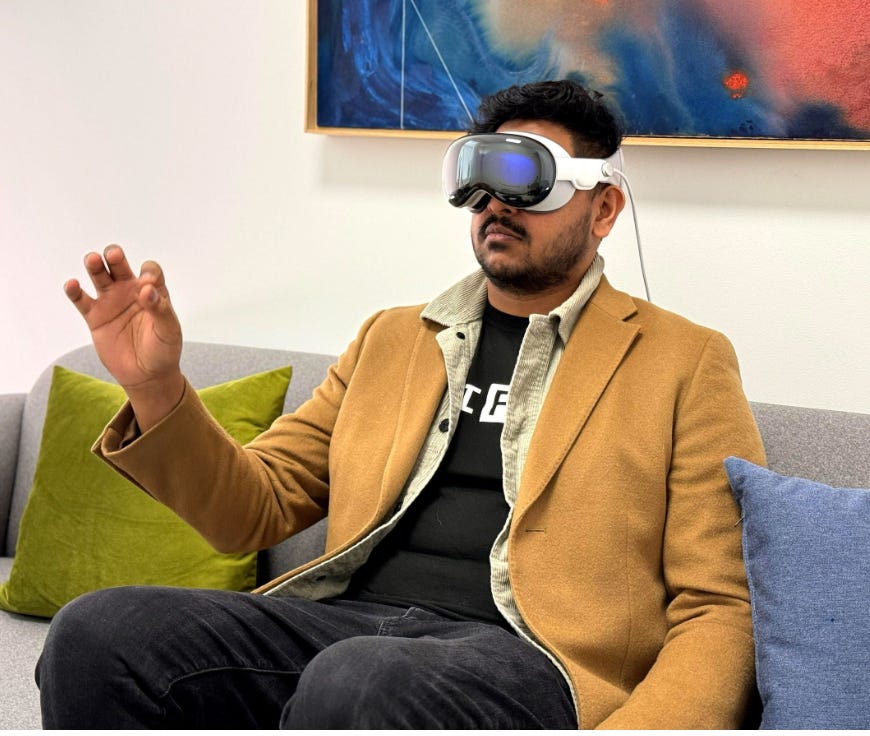
We can push back, we don’t need to accept everything foisted on us but we are easily fooled about what new fangled thing will make our lives better or easier. We need to be a bit more thoughtful and conscientious about what apps we allow into our lives and how that will reframe our behaviour either for the better or the worse.
It’s time to add a little more friction to our lives, to be purposefully inefficient. For the sake of your mental health, stand in the queue and be bored.
This is really excellent, Richard.
It’s really a challenge to intentionally add friction where it doesn’t already exist - we are so wired to just remove any possible feelings of discomfort in any way we can, but I like that framing. Friction is the foundation of growth.