
Quantum-mania
What is quantum computing and is it good, bad or indifferent

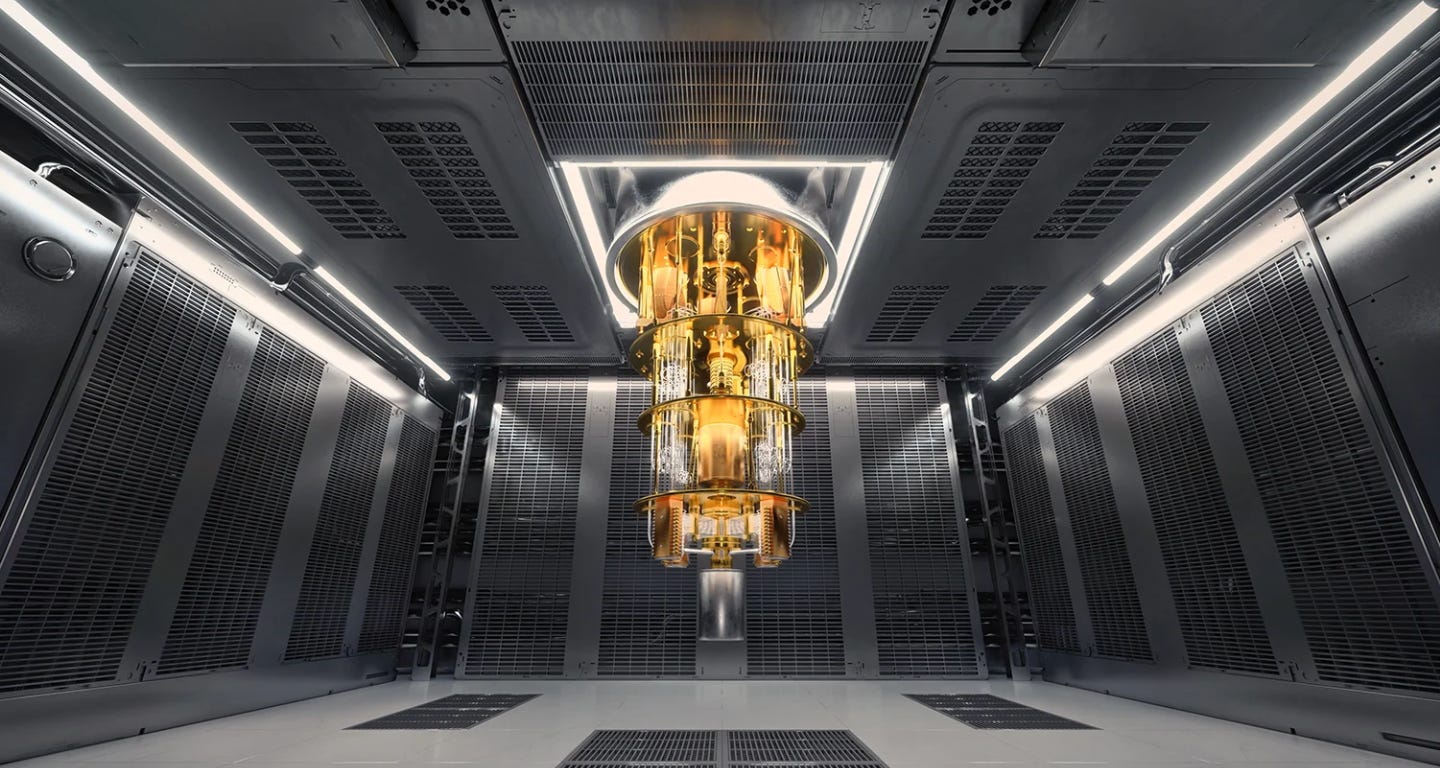
No picture of a computer goes as hard as pictures of Quantum computers. This thing looks like the brain of our future AI overlords housed in an anti-septic vault so high security that only Danny Ocean could dream of breaking in.
There’s a high likelihood that you’ve seen similar pictures and maybe even read headlines about Quantum computers breaking crypto or that the UK is committing £2bn to Quantum. But do you know what quantum is, what quantum computers do and whether it’s good/bad for the future? I’m guessing not so let’s dive in……
What even is quantum?
Before we lean into quantum computing, let’s first dive into quantum itself. Quantum theory differs from classical physics in that in classical physics, things can only be in one state at a time. A light switch either is on or off. A coin is either heads or tails. Things are binary.
Quantum, on the other hand, posits that two states can exist in the same space at the same time (until observed). The most well known quantum thought experiment is Schrödinger’s Cat. It’s not that the cat in the box is dead or alive. It’s that it’s both dead AND alive at the same time. Quantum theory is the theory of and rather than or. This is, of course, a mass oversimplification for the sake of a Substack post but if you’re keen to read more, may I suggest Helgoland.
OK, so how does this affect computing?
All non-quantum computing, from Charles Babbage’s Difference Machine right up to the most state-of-the-art AI system is based on a system of binary ones and zeros. Quantum differs in that it’s based on qubits. Qubits, a bit like Schrödingers cat, can be a one, a zero or both at the same time. This is called superposition.
Something called a register can be constructed from multiple qubits, which can then become correlated with each other in a subtle and powerful way that cannot exist in the ordinary, classical world — this is called quantum entanglement. The combination of superposition and entanglement means that a quantum register can encode information in a large number of states simultaneously allowing a quantum computer to tackle certain complex problems many times faster than modern classical machines.
This is why you may have heard that quantum would mean the death of encryption. Google Engineer, Craig Gidney estimated that a 1 million qubit quantum computer would take just 1 week to break RSA-2048 encryption. How long would it take with the binary Frontier Supercomputer - the most powerful supercomputer ever created that can exceed a quintillion calculations per second? 149 million years! Yeah, that’s the kind of step change we’re talking about in computing power.
Now, don’t get worried about changing all your passwords from “Password123!?” just yet. The largest quantum computer that we have is just 6,000 qubits. But they are scaling faster than Moore’s Law so 1 million qubits probably isn’t that far away.
Are they good for anything other than cracking passwords?
As a function of being able to utilise superposition in its computations, quantum computers are capable of much more complex tasks than traditional computers.
This can of course, be used for cracking passwords as I mentioned but, if you approach things with a pure heart, as all people reading this surely do, you can crack complexity in any number of other areas.
Quantum computers can simulate really complicated things in chemistry, materials science and nuclear physics. If you have a big complex chemical reaction and you want to figure out how it’s taking place, you have to be able to simulate a big molecule that has lots of electrons in a cloud around it. It’s a mess, and it’s hard to study. A quantum computer can, in principle, answer these questions. So you could use it to find a new drug.
Quantum computers excel at messy simulations because the real world is messy. So problems that you might think are relatively simple, like traffic optimisiation or supply chain efficiency or energy grid optimisation - problems that you might think have been solved but, in reality, haven’t, could be with the aid of quantum computation.
Harkening back to my post 2 weeks ago about fusion, Ryan Babbush, head of Quantum algo’s at Google gave the example of how quantum could help bring fusion forward. He said “The Department of Energy is already spending hundreds of millions of CPU hours if not billions of CPU hours, just computing one quantity.” Babbush and his collaborators outlined an algorithm that a quantum computer could use to model the reaction in its full complexity.
The universe is quantum at its base so one of the most exciting uses of quantum computing would be to create an actually realistic simulation of the universe and how it functions. A simulation that binary computers just can’t cope with. Imagine all the physics questions that remain unanswered right now that could potentially be answered once we’re able to model the universe on a computer that is designed how the universe actually is. A comment for my friend Alex here (lets see if he actually reads my newsletters) - if you believe in the simulation theory, it is likely that the simulation is running on some version of a quantum computer to capture the complexity of our world.
Who’s working on quantum?
There’s a mix of big companies and (well-funded) startups working on quantum. I’ve already mentioned Google a couple of times but IBM, Microsoft and Amazon are also working on quantum projects.
On the startup side there are lots of companies as more VC money pours into the space(over $2bn in the first half of 2025).
To touch on a few, you have Quantinuum (planning to IPO this year) who have built their own quantum computers for uses in things like security and computational chemistry. Quantinuum also offers access to their quantum cloud, kind of like how AWS allows you to access CPU’s and GPU’s. There’s also Nu Quantum, who just raised a $60m Series A, who are building a distributed quantum architecture to overcome scaling issues. Kvantify (not gonna lie, I chose them from a long list purely because that’s how I hear a person with a thick German accent saying quantify)utilise quantum computing to solve the most challenging problems in chemistry and biology with speed and precision in order to discover molecules that cure diseases.
Quanclusion
Quantum computing could have an incredible impact on the future. The ability to model the world and universe as it is will have a profound effect on our future. But the technology is nascent. It’s not there yet. And it’s important to note that it might never get there.
Anytime we’re talking about technology that is essentially still in the R&D phase, we need to ask two things “If this works, will it be good for humanity?” and “How likely is this to actually work?” Not asking those questions will get you a 5,000 word piece on the benefits of the Metaverse.
If quantum works, I think it’ll undoubtedly be good for humanity. The possibilities are endless from drug discovery to universe modelling.
Will it work? This is the hardest question to answer and I don’t have a definitive answer for you. After Meta wrote off $80bn on their Reality Labs, you can no longer say that the amount of money pouring into something is correlative with the likelihood of success. That being said, a lot of smart money is being poured into quantum. By some of the biggest companies in the world and some of the best investors. And it has worked, it’s just not scaled to where it needs to be yet. So if you ask me, will it work, my bet would be on yes. Eventually. Here’s hoping.
How can I get a job speeding the arrival of quantum?
You can find:
Nu Quantum careers here
Quantinuum careers here
PsiQuantum careers here